Publishedby the BESA team
May 22, 2024
Photo taken at the “Saint-Tite Western Festival” in 2017, during a “steer wrestling” event – Droit Animalier Quebec
Last Saturday, May 18th, 2024, a young steer died at the “Saint-Tite Western Festival” in Mauricie during a steer wrestling event. Behind this news story lies a very disturbing hidden side of our province: in Quebec, in 2024, animals can still be used as toys for entertainment entirely legally, even if their lives are put at risk.
The rodeo is a public spectacle meant to celebrate the work of “cowboys” on ranches, whose activities often required forcing horses or cows/bulls to submit to their will. It features various activities: riding a bucking horse or bull, calf roping, and many others. In Quebec, rodeos mainly appeared through what is now called the “Saint-Tite Western Festival,” which takes place every year in Mauricie. The event was initially launched in 1967 by a leather company that wanted to sell “western boots.” Far from any “tradition,” we’re talking about a show built entirely from scratch fairly recently for marketing reasons.
Photo taken at the “Saint-Tite Western Festival” in 2017, during a “calf roping” event – Droit Animalier Quebec
Although some activities at the Saint-Tite festival do not use animals—such as country music shows—a large part of the events still use horses, bulls, steers (young castrated bulls), and calves to entertain the crowds, all under the sponsorship of major companies like Coca-Cola, Ford, or Coors. These events are far from risk-free and without consequences for the animals.
In recent years, Quebec law professor Alain Roy and his team have investigated and documented rodeo practices at the festival, as well as the injuries and psychological distress that animals endure during these “shows.” In a comprehensive report submitted in 2018 to Quebec’s Ministry of Agriculture, Fisheries, and Food (MAPAQ), photos show terrified animals; twisted necks, horses falling, and a concussion. Yesterday, death struck one of these poor animals who never asked to be put on display.
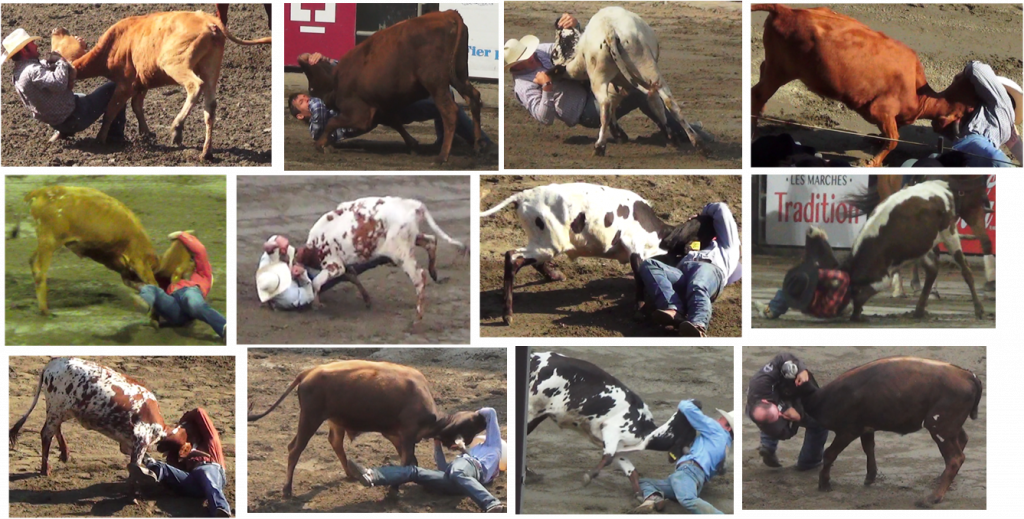
In rodeo jargon, there is the event of “steer wrestling,” which the animal that died last Saturday was a victim of. The principle is simple: a terrified young steer is released into the arena. A “cowboy” chases it on horseback, leaps onto it from his horse, and twists its neck one way, then the other even harder to force the animal to fall on its side. As cited by Jean-Jacques Kona-Boun, a veterinarian working on the rodeo file with Droit Animalier Quebec, “the steer wrestling event is dangerous and potentially fatal because it involves a rapid and brutal 180-degree cervical twist.”
Composition of several photos taken at the “Saint-Tite Western Festival” in 2017, during “steer wrestling” – Droit Animalier Quebec. It shows the strong twisting of the animals’ necks, almost completely turned around.
It is very difficult to accurately measure the risks endured by the animals used in this event. Like all industries that use animals, secrets are well kept and far from the public eye. It is only through people like Alain Roy and his team that we can have documented conditions for some animals that suffer the acts of the rodeo industry; but also the work of associations like Droit Animalier Quebec, which has brought the ethical problems linked to rodeo before the courts in recent years.
But even without quantifying the risks imposed on these animals, we can ask the question: why is it permitted to make animals take unnecessary risks in our province for the sake of amusement? What gives us this right? And why does it apply to horses and cattle, when we would be horrified to see it applied to cats and dogs?
Despite numerous protests and objections from Quebec citizens regarding rodeos, the government remains completely silent on the issue of animal welfare in our entertainment industries.
In Quebec, the Animal Welfare and Safety Act (also called the BESA law, after which our organization is named) recognizes that animals are sentient beings and must be protected from any mistreatment. And yet, the government allows them to be abused, terrified, and put at risk of injury and death in “shows” so that the rodeo industry can continue to exist. We are in the midst of complete cognitive dissonance! And this dissonance doesn’t stop at rodeos: as demonstrated by our investigations, a very large number of farm animals in Quebec also endure terrible practices that go completely against our values and their sentience.
But in the face of these dissonances that cost animals in our province their lives, we can act and put pressure on the government!
At BESA, we believe that country music, the “Western” culture, and the strength and talent of cowboys can be expressed without forcing animals to participate or be mistreated for entertainment. Our goal is not to make the Saint-Tite Western Festival disappear, but to ensure it can continue to exist in the future in a form that does not subject animals to risks and distress. Why should animals pay with their lives for our desire for a country atmosphere?
Respect for animals and their well-being are not just words that can be erased when it suits us; they are important values for Quebecers that demand integrity, consistency, and perseverance so that these values are applied in our province. Today, in the face of the tragic death of this poor anonymous animal, the question is once again being asked: will we do what is necessary to truly respect animals in Quebec?
Whether it’s by reducing your consumption of animal products, or by using your passion and talents to defend their rights, there are many ways to help animals in Quebec.
Discover the best ways to act simply, and at your own pace, for animals!

Like all websites, we use cookies (small temporary files) to keep our site running smoothly. These cookies store certain information about you, such as the web browser you use or the pages you visit. You can refuse their use by clicking on the buttons below, or read our privacy policy to find out more.