News

Less than 10 days to make your voice heard: the future of horses in Canada is at stake right now

Published by the BESA team

March 3, 2026

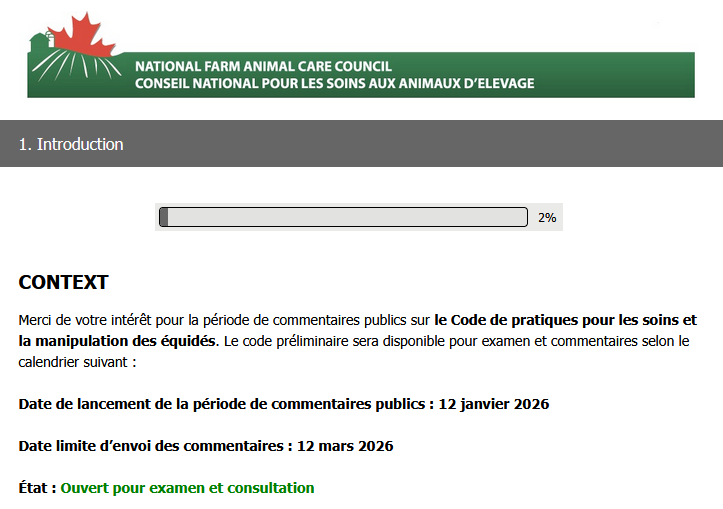
Canada is currently revising the Code of Practice for the Care and Handling of Equines, a reference document that sets the minimum welfare standards for horses, ponies, donkeys, and other equines nationwide. This long-awaited revision represents a crucial opportunity to improve the lives of thousands of animals.


But time is running out: there are fewer than 10 days left to participate in the public consultation and demand a Code that truly protects horses. BESA has already taken part in the consultation and invites anyone who cares about horse welfare to make their voice heard by the National Farm Animal Care Council. You’ll find suggested recommendations for each section of the consultation at the end of this text!

Why this revision is so important

Horses hold a unique place in our country, yet their legal protection remains surprisingly limited. All too often, horses are still victims of outdated or dangerous practices, and many continue to live in conditions that jeopardize their physical or psychological health. The revision of the Code is therefore a historic opportunity to address these shortcomings.

Some progress made... but the Code is still far too vague

While the proposed revision includes some improvements, several sections remain insufficient, ambiguous, or too permissive, risking the continuation of practices harmful to horse welfare. As is all too often the case with animal protection, legal loopholes ultimately benefit those who exploit animals rather than the animals we are supposed to be protecting.

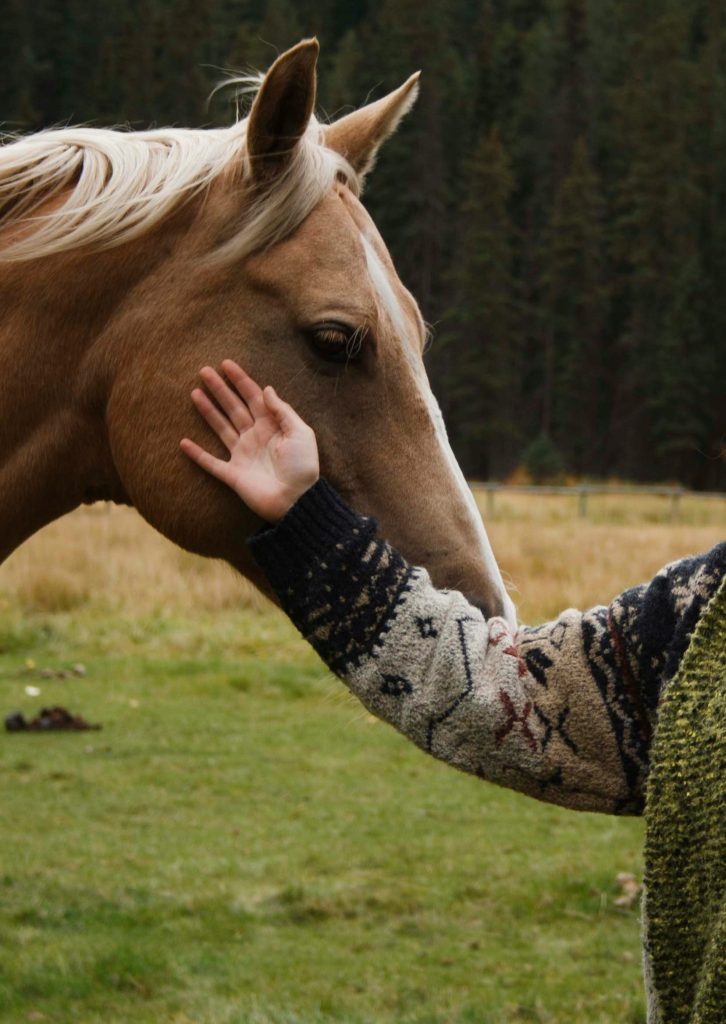
Horses are remarkably intelligent and sensitive animals. The revision of the Code of Practice is an opportunity to take action and ensure their rights are respected in Canada.

Several aspects that absolutely must be improved before the final adoption of the Code

A clear minimum age for weaning


Early weaning is one of the most stressful practices for young equines. Equine welfare experts point out that weaning too early leads to anxiety, behavioural issues, and long-lasting physiological impacts. The new Code must absolutely establish a mandatory minimum age for weaning, based on current scientific data, to prevent premature separations, which are unfortunately still common in Canada.

Stricter requirements for transportation


Transportation is one of the riskiest times for horses: injuries, heat stress, falls, dehydration, prolonged confinement… Equine protection organizations have long been calling for stricter rules, which, according to BESA, should be part of the new Code. BESA recommends tighter regulations to ensure the comfort of horses being transported, particularly regarding access to water and food, which should be mandatory for any transport lasting more than 6 hours.

Taking psychological well-being into account


Horses are social, sensitive, and intelligent animals. Their well-being isn’t just about the absence of injuries or reducing stereotypies once they’ve already developed. Truly caring for their psychological health means giving them the chance to express natural behaviours, have daily social contact, live in an enriched environments, and not be subjected to abuse or unnecessary discomfort during training.


The Code must reflect modern knowledge on animal welfare and learning theories by incorporating much clearer requirements for psychological well-being.


For example, section 7.2.1 of the current draft of the Code still allows the use of certain aversive tools, even though they are unnecessary and carry risks of pain, fear, and injury. These tools go against modern training practices based on positive reinforcement. The Code must clearly and unambiguously ban these tools.

In summary

  • Horses are still all too often victims of neglect or outdated practices
  • Current laws are insufficient to prevent abuse
  • A solid Code of Practice is essential for guiding owners, breeders, equestrian centers, and transporters.

It's your turn to act ! Suggest changes to the code of practice

You can help us and contribute to improving the new Code of Practice! It only takes a few minutes to complete the official form at the following link: https://fr.surveymonkey.com/r/6ZXVG7Z


You can provide specific comments for each section or leave general recommendations at the start of each one, for which you’ll find suggestions below.

Recommended suggestions

Section 1: Duties and Responsibilities


Require anyone who is responsible for a horse to have a basic understanding of behaviour, nutrition, health, and safety.


Clarify that responsibility implies an obligation to prevent avoidable suffering.

Section 2: Facilities and Accommodation


Establish clear and mandatory minimum dimensions for stalls and pens, based on the size of the horse.


Require daily access to a space that allows for natural behaviours and social interactions.


Prohibit keeping animals in stalls for long periods without access to the outdoors, and make it mandatory to remove soiled bedding at least once a day.

Section 3: Emergency Preparedness


Make emergency measure training for the caretaker and staff mandatory, along with proof of inspection for essential components.


Remove the statement indicating “It is therefore normal to avoid thinking about it, and even more so to avoid preparing for it.”

Section 4: Food and Water


Recommend permanent access to clean, safe water and near-constant access to forage, as fasting periods can lead to medical issues and increase the risk of stereotypic behaviours.

Section 5: Health Care Board


Mandate the maintenance of a treatment log for horses and keep all treatment receipts readily available to facilitate the enforcement of Code provisions during inspections.

Prohibit the use of tools or methods that cause pain or distress during care.

Section 6: Management of Free-Roaming Horses


Don’t just have a manure management plan; actively work on preventing buildup to keep the animals from getting uncomfortable.


Mandate minimum space requirements to ensure the physical and psychological well-being of grazing animals (section 2).

Section 7: Equine Management Practices


Clearly prohibit certain aversive tools mentioned in section 7.2.1 that are designed to cause pain and discomfort to animals and do not represent best practices in equine training. Explicitly encourage methods based on positive reinforcement.


Require that all equine castrations be performed by a veterinarian.

Section 8: Exercise and Training


This section contains serious contradictions. For example, it mentions that “the method used must not directly cause pain or fear in the horse,” yet the Code allows the use of aversive tools intended to cause pain or discomfort to the animal. Certain tools should be explicitly prohibited by the Code.

Section 9: Reproduction Management


Clarify the knowledge requirements for horse breeding.


Make it mandatory to ensure that the mare has a body condition score of at least 5 out of 9 before mating.


Set a minimum age for breeding mares and stallions.


Make postpartum veterinary follow-up a requirement for mares or jennies, especially if the birth did not go normally.


Clearly prohibit forced breeding practices.

Section 10 : Transport


Significantly reduce the maximum transport time without breaks, water, or food. The duration for vulnerable horses should never exceed 6 hours.

Section 11: Career Change and Retirement


Require a behavioural and physical assessment before any rehoming or redirection (leisure, therapy, adoption).

Section 12: Euthanasia


Define more clearly the criteria justifying euthanasia and the unacceptable methods for avoiding suffering, as well as the criteria for a person to be considered competent to perform it.

Thank you for taking action for the horses of Quebec and Canada !

You want to do more for them ?

Whether it’s by reducing your consumption of animal products, or by using your passion and talents to defend their rights, there are many ways to help animals in Quebec.


Discover the best ways to act simply, and at your own pace, for animals!